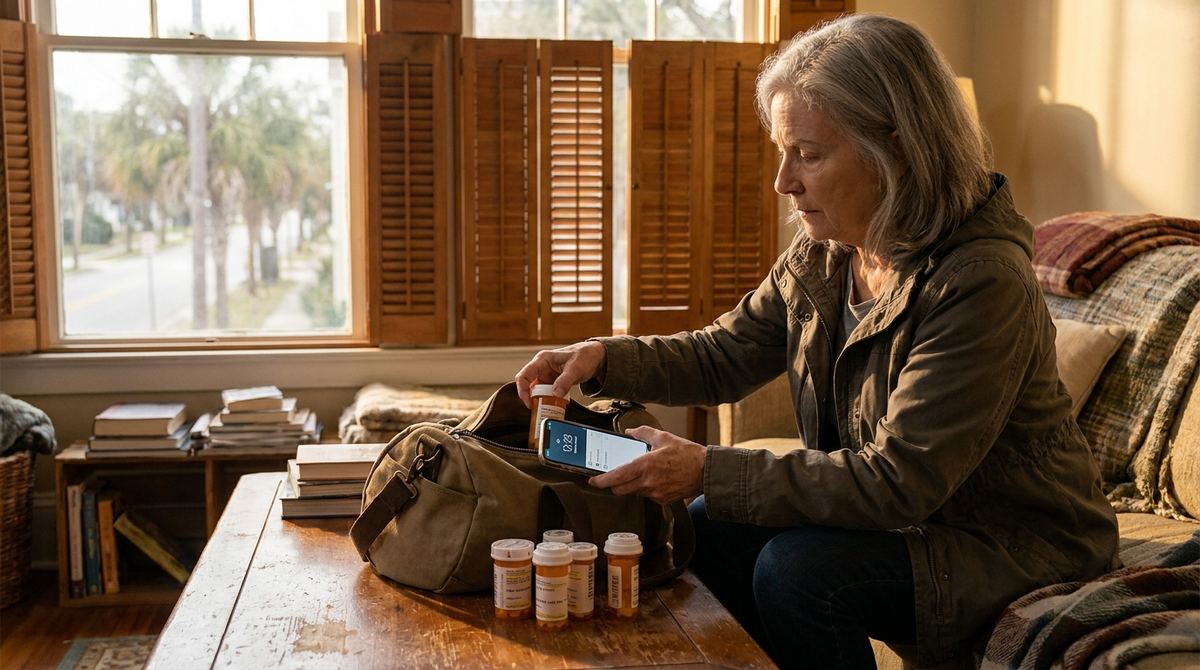
A hurricane, wildfire, or other severe weather evacuation throws off nearly every normal routine at once, and a medication schedule is one of the easiest things to lose track of in the scramble to pack and leave. Unlike a power outage at home, where the house and its supplies are still there, an evacuation means the whole routine, and often the medication supply itself, has to travel with you.
Keep your medication schedule steady, even away from home.
Try AmberCap free →Packing Medication Before the Storm Is Named
By the time an evacuation order is official, pharmacies in the affected area may already be closed, out of stock, or difficult to reach. Many pharmacies and emergency preparedness guides suggest keeping at least a week to two weeks of extra supply on hand during storm season specifically, packed together in a single bag that's easy to grab quickly rather than pills scattered across several rooms of the house.
Why Your Phone's Reminders Still Work Without Signal
A reminder that's already scheduled on your phone doesn't need an internet connection or cell signal to ring at the right time, since the alarm itself is stored locally on the device, not fetched from somewhere else in the moment. That means the actual reminder to take a dose keeps working through a power outage or a dead zone during evacuation travel, even when nothing else about your phone's connectivity is working.
Free for one medication. Add your full schedule with Premium.
Get started with AmberCap →What Actually Needs a Connection: The Family Alert
While the reminder itself works offline, an email alert to a linked family member does need a working connection at the moment it's sent, since it's an actual message traveling over the internet. If you know you're heading somewhere with unreliable service, tell your linked family member ahead of time so a quiet stretch with no alerts doesn't get misread as bad news instead of just a dead zone.
Keeping the Battery Charged When Power Is Unreliable
A reminder can't ring on a dead phone, so a portable charger or a couple of spare battery packs are worth adding to an evacuation bag specifically for this reason, on top of any general emergency kit you already have. A phone kept at low power mode during a long displacement stretches battery life considerably while still keeping scheduled alarms fully functional.
A Written Backup Beats Relying on Memory Alone
Even with a reliable app reminder, keeping a simple written list of medications, doses, and times in a wallet or bag is worth doing before an evacuation, in case a phone is lost, damaged, or simply out of battery for an extended stretch. That same written list is also useful if you end up needing care at an unfamiliar clinic or shelter medical station that has no access to your regular pharmacy's records.
Staying on Schedule in an Unfamiliar Place
A hotel room, a relative's house, or a shelter cot all lack the usual visual cues, a pillbox on the kitchen counter, a routine tied to breakfast, that normally help keep a medication schedule on track at home. Leaning more heavily on the app's actual alarm during this stretch, rather than the environmental habits that usually do some of the work, matters more than usual precisely because those habits are temporarily gone.
Replacing Medication Left Behind
If medication does get left behind in a rushed evacuation, many states have emergency prescription refill provisions that pharmacies can use during a declared disaster, even without the original bottle in hand. Having your medication list (from the app's history or a written backup) ready to show a pharmacist speeds up that process considerably compared to trying to recall everything from memory under stress.
Building an Evacuation-Ready Medication Kit Before Storm Season
Rather than assembling a medication kit in a rush once a storm is already forecast, put it together at the start of the season and simply refresh it every few months so nothing expires unnoticed. A small waterproof bag with a two-week supply, a written medication list, and a portable charger, kept somewhere easy to grab, turns a stressful last-minute scramble into a five-minute grab-and-go.
Special Considerations for Refrigerated Medications
Insulin and some other medications need refrigeration, which complicates evacuation planning since a cooler and ice packs become part of the kit, not just the medication itself. Ask a pharmacist ahead of storm season how long a specific refrigerated medication stays stable without cooling, so there's a clear answer in hand rather than a guess if a cooler runs out of ice during a longer displacement than expected.
Rebuilding the Normal Schedule After Returning Home
Once the evacuation is over and the normal routine resumes, take a few minutes to review the reminder schedule and confirm nothing needs adjusting, especially if any doses were missed, delayed, or taken at unusual times during the disruption. A quick review closes the loop on the event instead of leaving lingering uncertainty about whether the schedule is still accurate.
Preparing Before Storm Season Starts, Not After a Warning
The best time to review an evacuation medication plan is at the start of storm season, not once a specific storm is already being tracked and pharmacies are getting busy. Set a yearly reminder for yourself to check expiration dates on the extra supply, confirm the written list is current, and make sure any refrigerated medication plan still makes sense before it's actually needed under pressure.
What to Tell an Unfamiliar Shelter Medical Team
If you end up needing care at a shelter or an unfamiliar clinic during a displacement, a medical team there has no history with you and no access to your regular pharmacy's records. Leading with your medication list, allergies, and any major conditions upfront, rather than waiting to be asked, gets you appropriate care faster than a team having to piece that picture together from scratch.
Keeping a copy of that list in more than one place, a phone, a wallet card, and a bag tag, means it's still available even if one of those items gets separated from you during a chaotic evacuation.
None of this preparation needs to be elaborate. A little planning done calmly before storm season, rather than scrambled together while a warning is already active, is usually the difference between a stressful evacuation and a merely inconvenient one.
Helping a Neighbor Who Doesn't Have Family Nearby
Not every senior evacuating has a family member coordinating from a distance, and an elderly neighbor living alone can be easy to overlook in a rushed evacuation. A quick check on whether a neighbor has enough medication packed and a working way to charge their phone takes only a few minutes and can matter far more than it seems in the moment, especially in a community where several older residents live independently near each other.
A brief knock on the door before evacuating costs almost nothing and can genuinely make a difference for someone who has no one else checking in on them during a chaotic stretch.
Frequently Asked Questions
What's the biggest medication risk during an evacuation?
Leaving without enough medication to last through the displacement, or losing track of the schedule entirely once the normal routine at home is disrupted. Both are common and both are preventable with a bit of preparation before severe weather even becomes a real threat.
How much extra medication should I pack for an evacuation?
Many pharmacies and emergency preparedness guides suggest at least a week to two weeks of supply when possible, since shelters, hotels, and evacuation centers may not have easy pharmacy access, and returning home can take longer than expected.
Will medication reminders still work if I lose power or cell service during a storm?
A reminder already scheduled on your phone will still ring at the right time, since your phone doesn't need an internet connection to sound an alarm it already has stored. A family email alert, however, does need a working connection to actually send.
Should I tell my linked family member I'm evacuating?
Yes. If they're used to getting missed-dose alerts and don't hear from you at all during a storm, they may not know whether that means everything is fine or that something has gone wrong. A quick heads-up before you lose signal avoids that confusion.