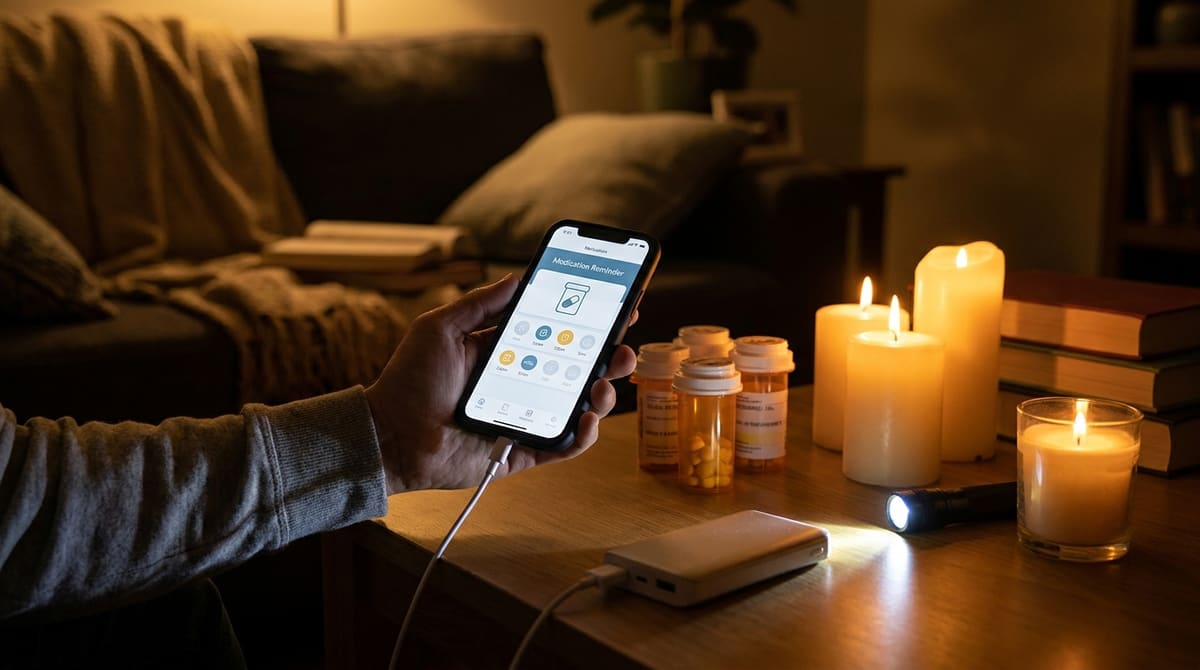
A power outage doesn't stop medications from needing to be taken on time, but it can quietly stop every alert meant to make that happen. Between a phone battery running down with no way to charge it and a wifi router losing power entirely, a good stretch of hours can pass with no reminders firing at all, right when routines are already disrupted.
Keep alerts running even when the power doesn't.
Try AmberCap free →Cellular Phones Hold Up Better Than Wifi Devices
A phone on a cellular plan keeps sending and receiving alerts through an outage as long as its battery holds and the local cell tower stays up, which is usually the case even when home power is out. A wifi-only tablet doesn't have that fallback, so it goes silent the moment the router does.
Why a Cheap Power Bank Matters More Than It Seems
A charged power bank kept in a drawer solves the single most common failure point in this situation: a dead phone battery with nowhere to plug in. It's a small, inexpensive habit that closes most of the actual risk, similar in spirit to keeping a backup plan ready for medication reminders during holiday travel, where the phone is again the single point of failure.
Free for one medication. Add the full list with Premium.
Get started with AmberCap →A Simple Pre-Storm Checklist Worth Having
Ahead of a forecasted storm or planned outage, charging every relevant device fully, checking that a power bank itself is charged, and confirming which family members are on a cellular plan rather than wifi-only closes most of the gaps before they become a real problem mid-outage.
What to Do if an Outage Happens Without Warning
If a phone is already low on battery when the power goes out, switching it to low-power mode immediately buys extra hours for the alerts that matter most. A quick check-in call to confirm doses were taken on schedule is a reasonable backup for the first day of an unexpected outage.
Why a Backup Contact on a Different Network Helps
A widespread outage sometimes affects an entire neighborhood or even a whole cell tower's coverage area at once, so having a family alert reach someone on a different carrier or in a different part of town adds real redundancy rather than everyone relying on the exact same infrastructure that's already down.
Car Chargers Are an Underused Backup Option
A car sitting in the driveway is effectively a large battery with a charging port already built in, and running it briefly to top off a phone is a reasonable fallback if a power bank isn't available or is already drained. It's a detail easy to forget in the moment, but worth mentioning to anyone unfamiliar with the option ahead of a storm season.
Refrigerated Medications Add a Second Clock to Watch
Insulin and a handful of other medications need refrigeration to stay effective, which means an extended outage threatens more than just the reminder itself, it threatens the medication's usability. Most refrigerated medications tolerate a few hours above temperature fine if the fridge door stays closed, but it's worth knowing the specific guidance for each medication rather than assuming they're all equally forgiving, similar to the care already taken around insulin timing under normal conditions.
Building a Habit Around Testing the Backup Plan
A power bank that hasn't been checked in months can turn out to be dead itself exactly when it's needed, which defeats the entire point of having one. Testing it briefly every few months, the same way a household might test a smoke detector, turns an assumed safeguard into one that's actually confirmed to work rather than just hoped to.
Neighbors and Community Check-Ins Fill a Real Gap
Technology backups (power banks, car chargers, cellular data) all have limits, and a neighbor or a community wellness check program willing to physically check in during an extended outage covers the scenario where every piece of electronic backup eventually runs out. For a senior living alone, having at least one non-technical fallback lined up ahead of time closes the gap that no amount of charged batteries can fully cover during a truly extended outage.
Writing Down the Plan Somewhere Non-Digital Too
An outage that takes down every device at once also takes down any digital note explaining what to do, so a simple paper card near the medication cabinet listing the backup plan (where the power bank is kept, which family member to call, what the medication schedule actually is) gives a working fallback even if every screen in the house is dead. It's a low-tech detail that matters precisely because the rest of the plan depends on electronics that can fail all at once.
Reviewing that card once a year, ideally around the start of storm season in areas prone to one, keeps it accurate as phone numbers, medications, and backup devices inevitably change over time. A five-minute yearly check is a small price for knowing the paper backup would actually work the one time it's genuinely needed.
Solar Chargers Are Worth Considering for Frequent Outage Areas
In regions where outages happen often enough to be a recurring concern rather than a rare event, a small solar charging panel kept near a window offers a backup that never runs out the way a power bank eventually does. It's a bigger upfront investment than a basic power bank, but it's worth it specifically for households that see multi-day outages more than once a year, since the cost pays for itself after just a couple of extended outages compared to repeatedly buying replacement batteries.
Frequently Asked Questions
Does a power outage stop a medication reminder app from working?
A charged phone keeps working fine on cellular data during an outage. The real risk is a phone battery dying with no power to recharge it, or a wifi-only device losing its connection once the home router goes down.
How long can a phone realistically last during an extended outage?
A modern phone with light use can often last a full day or more, but a phone actively being checked, texted on, and used for calls during a stressful outage drains much faster than normal daily use would.
Is a portable power bank worth keeping specifically for this?
Yes, and it's one of the cheapest, most reliable safeguards available. A charged power bank sitting in a drawer means a dead phone battery mid-outage is a quick fix instead of hours without any reminders or alerts at all.
What if the senior's device is wifi-only, not cellular?
A wifi-only tablet loses its connection the moment the router loses power, even if the tablet itself still has a full battery. That's worth knowing ahead of time, since it changes what a backup plan actually needs to cover.