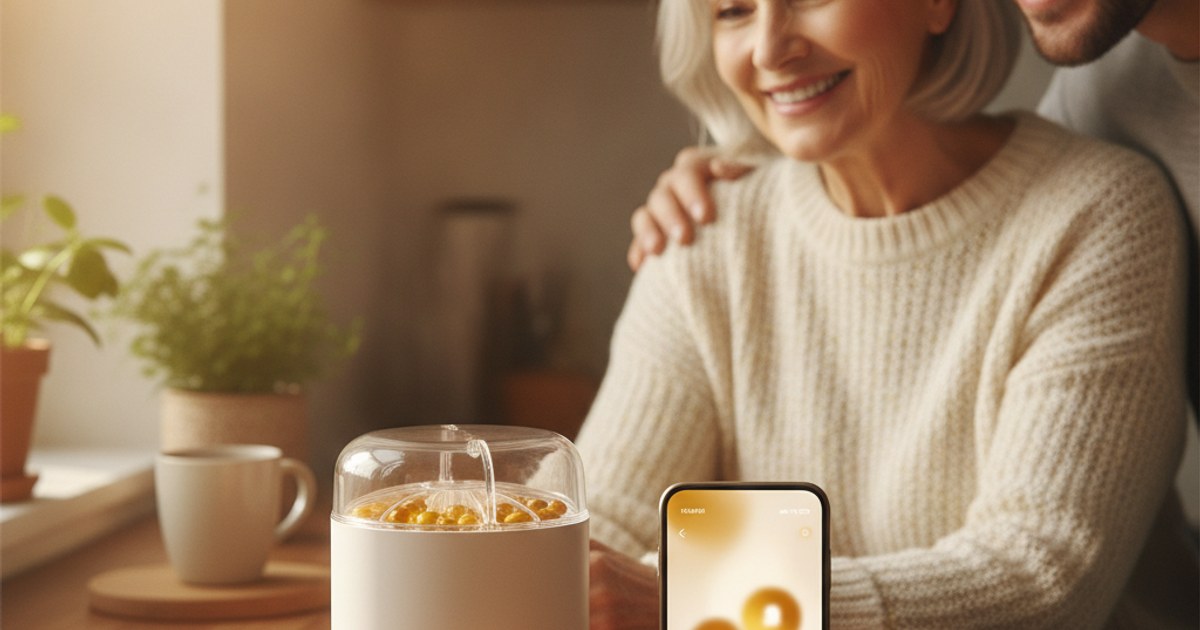
Once medication starts getting missed regularly, the two options that usually come up are an automatic pill dispenser, a machine that locks pills away and releases them on a schedule, or a pill reminder app on a phone. They sound like they solve the same problem, but they're actually built for two fairly different situations, and picking the expensive one first isn't always the right move.
Before spending hundreds on hardware, AmberCap lets you test whether a free reminder app with alarm-volume alerts and family notifications already closes the gap.
Try AmberCap free →What Each One Actually Solves
An automatic dispenser physically controls access to pills, they're locked in a cartridge and only released at the scheduled time, usually with a light and sound. That's genuinely useful when there's a real risk of taking the wrong pill, taking a dose twice, or accessing medication outside of the intended schedule, situations more common with advanced cognitive decline. A reminder app doesn't touch the pills at all, it reminds, tracks, and alerts, while the person still opens their own pillbox or bottle themselves.
The Cost Difference Is Bigger Than It Looks
A dispenser is a one-time purchase of $150 to $400 for most consumer models, and several also charge a recurring monitoring fee for the connected alerts to work at all. A reminder app is typically free to try on a single medication and stays inexpensive even upgraded. For a family still figuring out whether the issue is timing, memory, or something more serious, that price gap makes the app the obvious place to start.
Where a Dispenser Genuinely Wins
If someone has already taken a dose twice by accident because they forgot the first one, or if there's a real safety concern about accessing medication outside a schedule, a dispenser's physical lock solves something an app simply can't. That's a narrower case than most people assume it is, but where it applies, it's the right tool.
Where a Reminder App Genuinely Wins
For the far more common situation, someone forgets a dose because a quiet notification got missed, or a family member has no visibility into whether medication is being taken at all, an app closes the gap without hardware, without a mechanical part that can jam, and with a family alert that a basic dispenser rarely includes without an extra subscription.
A Simple Way to Decide
- Start with a free reminder app and use it for two to three weeks.
- If doses still get missed because the reminder isn't loud or visible enough, look at accessibility settings before assuming it's an app problem.
- If the real issue is confusing which pill to take or a risk of double-dosing, that's the dispenser's actual use case.
- If the issue is simply forgetting or a family member wanting visibility, the app alone is usually enough.
Frequently Asked Questions
Is an automatic pill dispenser better than a pill reminder app?
Better depends on the problem. A dispenser physically locks pills away until the right time and dispenses them, which helps with cognitive decline or a risk of double-dosing. A reminder app is cheaper, works with whatever pillbox or bottles someone already uses, and adds features like family alerts that most dispensers don't include.
How much does an automatic pill dispenser usually cost?
Most run anywhere from $150 to $400 upfront, plus some models charge a monthly monitoring fee on top of that. A pill reminder app is typically free for a single medication and far cheaper even on a paid tier, which matters when you're not yet sure the automation is necessary.
Can I use a reminder app and a dispenser together?
Yes, and some families do exactly that, a dispenser for physically holding and releasing pills and an app for scheduling awareness and family alerts. They solve different halves of the same problem rather than competing with each other.
What happens if a dispenser jams or runs out of pills?
That's the most common complaint with hardware dispensers, a mechanical jam or an empty tray needs a physical fix, and if no one notices in time, the reminder simply doesn't happen. A phone-based app doesn't have moving parts to fail in the same way.
Does a reminder app work for someone who forgets to check their phone?
An app built with alarm-volume reminders rings the way a real alarm clock does, not a quiet notification easy to miss. That closes most of the gap with a dispenser's physical alert, without the cost or the parts that can break.
Which one should I start with?
Start with a reminder app. It's free to try, takes minutes to set up, and tells you exactly where the real gap is, missed timing, missed marking, or an actual physical dispensing problem, before spending hundreds of dollars on hardware that may solve a problem you don't actually have.
Free for one medication, no card required. Rule out the cheaper fix before buying hardware.
Get started with AmberCap →